AI Exposure and Firm Outcomes
This study separates theoretical AI capability, observed industry usage, and firm engagement measured from public SEC filings. Event-study and panel tests ask whether that firm-level signal predicts market reactions or later operating outcomes, while specification changes expose how fragile a pricing story would be.
Public text enters the measurement field.
Research premise
Turn public text into an empirical test
Does a firm's exposure to artificial intelligence show up in its stock returns or its operating fundamentals?
Public filing language becomes useful only when it can be compressed into a measurable signal and survive tests against observable outcomes.
Whether a public, pre-ChatGPT firm-level signal is associated with market reactions or later operating outcomes.
Whether AI caused a particular return, productivity change, or management decision.
Answer first
A firm-level AI measure built from 10-K text produces no robust stock-price reaction to ChatGPT and does not predict later revenue per employee or operating margin.
Boundary. Industry capability and observed usage correlate at 0.90 after aggregation, while event-study conclusions remain sensitive to pre-trends and the choice of risk model.
Measurement
Three measures, two levels of analysis
Capability, observed usage, and firm engagement describe different layers of the same phenomenon.
Occupation scores describe theoretical capability. Public usage data describes what industries appear to be doing. SEC 10-K language supplies a distinct firm-level engagement measure before the ChatGPT release.
Measurement notebook
Schematic marks, not observations
Triangles represent theoretical capability, circles represent observed usage, and squares represent firm engagement measured from public SEC 10-K text. The mark positions are schematic, not plotted observations. Industry capability and usage correlate at 0.90 after aggregation, while the firm measure correlates only 0.20 with industry capability. The firm measure produces no robust stock-price effect and does not predict later productivity or operating margin.
Swipe to inspect the full axis
Hover the figure, or step through with these buttons
The order of the marks is schematic. The measures and the null result are from the paper; the positions are not plotted observations.
Identification consequenceAt industry level, capability and usage move together at r = 0.90. The firm measure relates much more weakly to industry capability at r = 0.20, making it distinct enough to test, but not automatically useful for prediction.
Research design
Test the signal at three checkpoints
The analysis moves from measurement validity to market pricing and then to operating fundamentals.
10-K engagement measure
Public pre-ChatGPT SEC 10-K text is converted into a firm-level AI engagement measure, distinct from occupation-based capability and observed industry usage.
Event-study specifications
ChatGPT-window abnormal returns are re-estimated under a single index, a market model, and Fama–French five factors so sign changes remain visible.
Firm-outcome panel
A 2017–2024 panel with firm and year fixed effects tests subsequent revenue per employee and operating margin rather than inferring outcomes from attention.
Market evidence
The pricing result changes with the risk model
A market response should survive reasonable choices about how abnormal returns are measured.
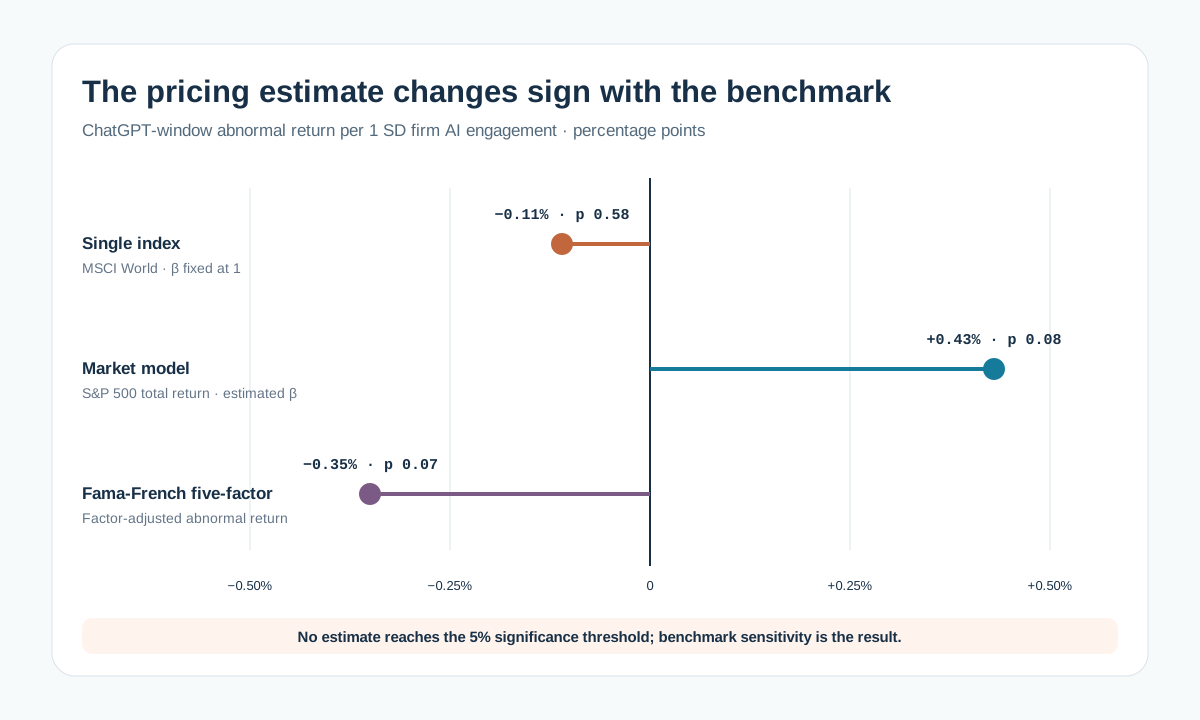
Coefficient plot showing the estimated ChatGPT-window return changes sign across three risk models and is not significant at five percent. Public AI Exposure working paper.
Text equivalent
ChatGPT-window abnormal return per one standard deviation of firm AI engagement: single index −0.11% (p = 0.58), market model +0.43% (p = 0.08), and Fama-French five-factor −0.35% (p = 0.07). No estimate is significant at five percent, and the sign changes with the risk model.
Why this mattersThe coefficient changes sign across the single-index, market, and Fama–French specifications. No estimate clears the five-percent threshold, so one attractive specification cannot carry the conclusion.
Operating evidence
The signal does not travel into fundamentals
Attention in filings is only economically meaningful if it anticipates something observable in firm performance.
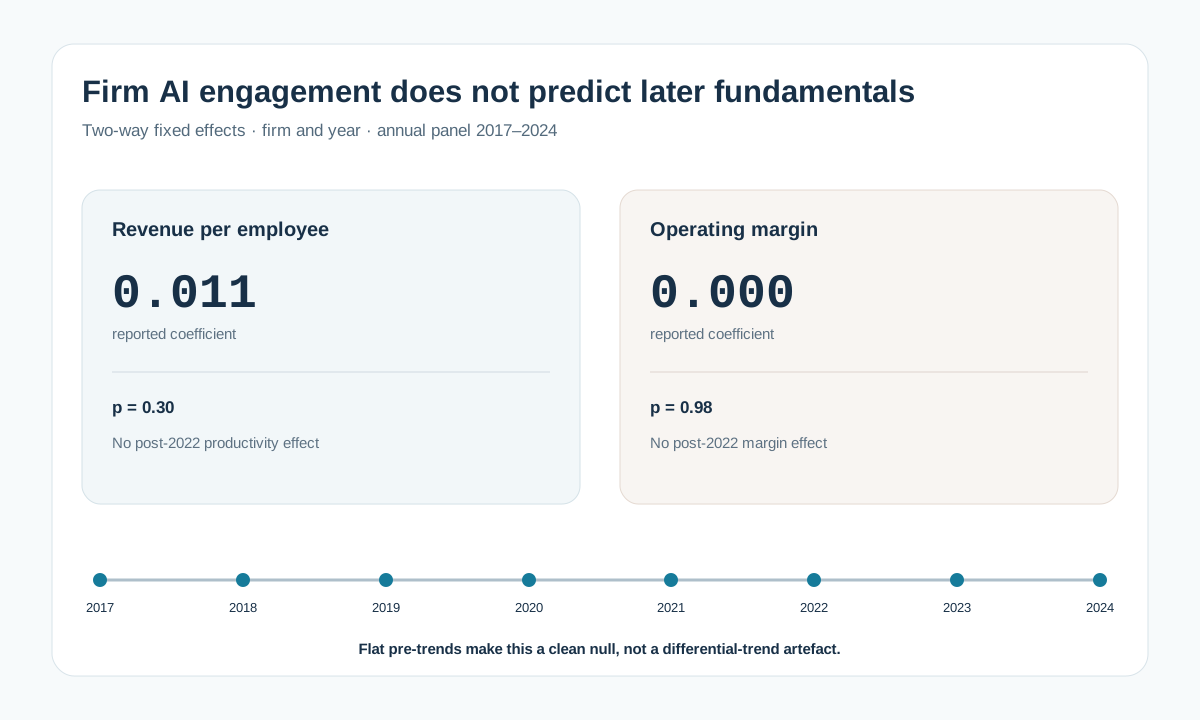
Two outcome cards reporting no predictive effect of firm AI engagement on revenue per employee or operating margin from 2017 to 2024. Public AI Exposure working paper.
Text equivalent
In a 2017–2024 panel with firm and year fixed effects, firm AI engagement does not predict revenue per employee (coefficient 0.011, p = 0.30) or operating margin (coefficient 0.000, p = 0.98). Flat pre-trends support the null interpretation.
In the 2017–2024 fixed-effects panel, firm engagement does not predict revenue per employee or operating margin. Flat pre-trends make the null result more credible; they do not turn it into proof that AI never matters.
Interpretation
Distinct measurement is not predictive success
The contribution is a disciplined separation between a measurable construct and a predictive claim.
A firm-level AI measure built from 10-K text produces no robust stock-price reaction to ChatGPT and does not predict later revenue per employee or operating margin.
Verified metrics
- 0.90Industry capability–usage correlation
After four-digit NAICS aggregation, capability and observed usage are too closely aligned to identify separate industry stories.
Verify in public source - 0.20Firm–industry correlation
The 10-K engagement measure has only a weak relationship with industry capability, supporting its use as a distinct firm-level signal.
Verify in public source - p = 0.98Operating-margin test
The fixed-effects panel reports a near-zero coefficient for later operating margin, consistent with no predictive effect.
Verify in public source
MEASURABLE ≠ PREDICTIVE
No robust stock-price or operating signal
Specification choice still moves the pricing result
The public firm-level measure is empirically distinct, but shows no robust pricing or operating-performance signal in these designs.
Industry capability and observed usage correlate at 0.90 after aggregation, while event-study conclusions remain sensitive to pre-trends and the choice of risk model.
Public record
Evidence archive
Every number shown above can be traced to a public repository or archived research output.
- 01Comparison showing a 0.90 industry capability-usage correlation and a 0.20 firm-engagement correlation with industry capabilityVerify
Industry AI capability and observed usage correlate at 0.90 after four-digit NAICS aggregation, so they cannot be separated as industry measures. Firm engagement measured from pre-ChatGPT public 10-K text correlates only 0.20 with industry capability and is a distinct firm-level signal.
- 02Coefficient plot showing the estimated ChatGPT-window return changes sign across three risk models and is not significant at five percentVerify
ChatGPT-window abnormal return per one standard deviation of firm AI engagement: single index −0.11% (p = 0.58), market model +0.43% (p = 0.08), and Fama-French five-factor −0.35% (p = 0.07). No estimate is significant at five percent, and the sign changes with the risk model.
- 03Two outcome cards reporting no predictive effect of firm AI engagement on revenue per employee or operating margin from 2017 to 2024Verify
In a 2017–2024 panel with firm and year fixed effects, firm AI engagement does not predict revenue per employee (coefficient 0.011, p = 0.30) or operating margin (coefficient 0.000, p = 0.98). Flat pre-trends support the null interpretation.